
With the Senedd election approaching, we reviewed the manifestos of all six main parties…so you don't have to!
Looking at them through the safer sport lens that shapes our work at Kyniska, we’ve highlighted where commitments to athlete welfare, preventing violence against women and girls, and education are present, and where they’re missing.
Because sport is devolved in Wales, the outcome of the Senedd election on 7 May will directly shape how sport is governed, and ultimately, how safe it is for everyone involved.
Comparison:
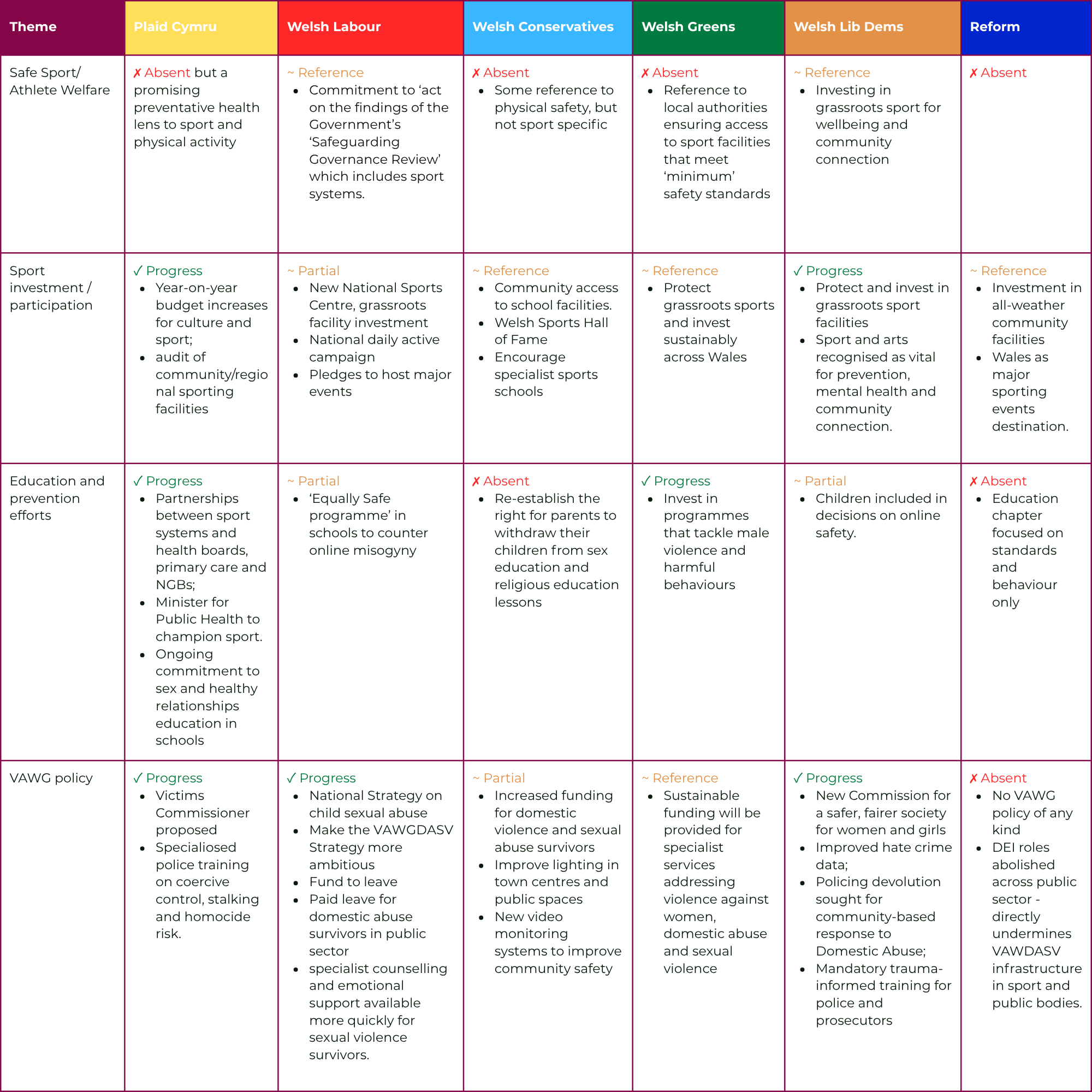
The table below offers a snapshot across six parties and four themes we consider central to safer sport. We chose these themes because they reflect the areas where policy decisions at the Senedd level can make a tangible difference: whether athletes are protected, whether communities have access to sport, whether young people receive education that helps prevent harm, and whether violence against women and girls is taken seriously as both a societal and a sport-specific issue. Following the table, we discuss four key themes that cut across the parties and point to where the real gaps lie.
Key: ✓ Progress | ~ Partial or Reference | ✗ Absent
Absence of a policy is treated as a finding, not a neutral position.
Key Takeaways
1. Responding to the Government’s ‘Safeguarding Governance Review’
We will be watching closely to see how the new Welsh Government responds to the ‘Safeguarding Governance Review’ commissioned by the outgoing government. For the first time, the review explicitly includes sport within its scope. By its inclusion, it acknowledges that sport is a risk area for harm and should not be separate from the wider safeguarding landscape in Wales.
Sport is rarely recognised as a site of abuse in Welsh legislation, frameworks and conversations about violence against women and girls. Currently, sport in Wales is not governed by an equivalent statutory safeguarding duty found in education, healthcare and social care setting, despite high-levels of abuse, male-dominated leadership, and being characterised by strong power hierarchies and toxic masculinity cultures. This lack of governance and accountability leads to inconsistency in process, education, and response across Wales, leaving athletes at a heightened risk .
Unsurprisingly, it is only Labour, who called for the review, who have made a manifesto commitment to act on the Review’s recommendations. Though none of the manifestos reference changes to sport safeguarding governance, the safeguarding review should point to areas where sport must be included in wider safeguarding governance and infrastructure, and where critical gaps can be closed. Whoever takes office in May will inherit both the Review's findings and the responsibility to act on them.
2. 'Safer sport' is interpreted as physical infrastructure
Where 'safety' appears in relation to sport and women across many of these manifestos, the framing is almost entirely physical: improved street lighting, CCTV cameras, female-only toilets and changing rooms. The Welsh Conservatives are the clearest example, promising a ‘Safer Streets Fund’ and commitment to improved town centre lighting appear under community safety.
While there is, of course, a need for athletes to feel safe in their physical communal spaces, the absence of commitments to improving safeguarding standards, abuse prevention, or athlete welfare shows a lack of understanding of the extent of harm and the varying forms of harm, including a rise in online harm, athletes face.
Additionally, some of the manifestos lean into a broader rise in political rhetoric about “protecting women’s sport”, language that, in practice, is often less about safeguarding women from abuse and more about regulating who is permitted to participate. From a safe sport perspective, meaningful protection would centre independent oversight, reporting mechanisms, power imbalances and accountability within sport itself. When those elements are absent, the promise of protection reads as symbolic rather than structural, and risks obscuring the realities of harm that women in sport continue to face.
The result is a consistent pattern of parties investing in the infrastructure of sport without investing in the conditions that make sport safe to participate in.
3. Shifting sport towards health and wellbeing
There are signs Wales may be starting to move beyond treating sport purely as an economic tool. Several parties make the link between sport and community cohesion, health prevention, and long-term wellbeing well: all elements that must be understood to create healthy sport environments. This stands in contrast to approaches that frame sport primarily in terms of revenue generation or national prestige.
Moving away from ‘win-at-all-costs’ thinking is not just a change in emphasis, but a challenge to the cultures that have long been tolerated within sport—where toughness is prioritised, harmful behaviours are normalised, and welfare is secondary to performance. Environments that centre wellbeing are more likely to question these norms, rebalance power, and create conditions where harm is less likely to be overlooked or excused.
Plaid Cymru goes furthest in substance. Their commitments include auditing community and regional facilities to assess investment needs, alongside building partnerships between health boards, primary care, and sports governing bodies. A proposed Minister for Public Health would further position sport within a preventative health agenda.
These proposals create an opportunity to improve safety, but only if they go beyond infrastructure. An audit that measures not just provision, but governance, culture, and safeguarding standards would mark a meaningful step forward. A public health framing could also sharpen recognition of harm and strengthen support for those affected.
The Liberal Democrats’ explicit links between sport, mental health, community cohesion, and lifelong participation, alongside Labour’s national daily activity campaign, signal a similar intent to broaden how sport is understood and delivered.
Across all parties, however, the same gap persists: expanding access without addressing the underlying cultures and safety risks may bring more people into sport, but does not guarantee those environments are fit for purpose.
4. From VAWG policy to sporting practice
Across the Welsh manifestos, there are credible commitments to tackling violence against women and girls. Wales does not hold the same devolved powers over criminal justice as Scotland, where several parties have set out more explicit legal and legislative ambitions ahead of their election (see our analysis of Scottish manifestos). Within its remit, some Welsh parties are instead focusing on prevention measures, public health approaches, and strengthening support systems.
There are some indications of a shift towards prevention, including commitments to challenge harmful male behaviours and embed education in schools. However, this emphasis is uneven, and much of the detail remains weighted towards responses after harm has occurred. The Lib Dems’ commitment to trauma-informed practice, Plaid’s improved training for police and public services to recognise coercive control and abuse, and Labour’s continued investment in specialist support are all positive steps toward a more developed approach to responding to people with lived experience of harm. Plaid’s proposal of a Victims’ Commissioner may strengthen oversight, but their role in driving prevention, or how the role would differ to the existing Victims’ Commissioner for England and Wales is not clearly articulated.
With a clearer recognition of sport as a site of abuse, and a further nudge toward preventative measures, this existing ambition on VAWG could provide a credible foundation for extending prevention, training, and support into sporting environments.
With a growing emphasis on wellbeing and prevention across all sectors in Wales, and the inclusion of sport within wider safeguarding structures through the Safeguarding Governance Review, the conditions for more coherent and consistent approaches to safety in sport are beginning to take shape. Realising that potential will depend on whether sport is fully integrated into these agendas, rather than continuing to sit at their margins.
What’s the solution?
Read our programme for the new Senedd:
English: ‘Safer Sport Priorities for Cymru’
Cymraeg: 'Blaenoriaethau Chwaraeon mwy Diogel i Gymru'