
With the Scottish Parliament election on the horizon, we reviewed the manifestos of all six main parties…so you don't have to!
Through the safer sport lens of our work here at Kyniska, we have identified where parties have (and have not) made commitments to athlete welfare, violence against women and girls, and education for prevention.
Sport is devolved to Scotland, which means the outcome of the Scottish Parliament election on 7th May will have a direct impact on how sport is run in Scotland, and crucially, how safe it is for the people who take part in it.
The Comparison
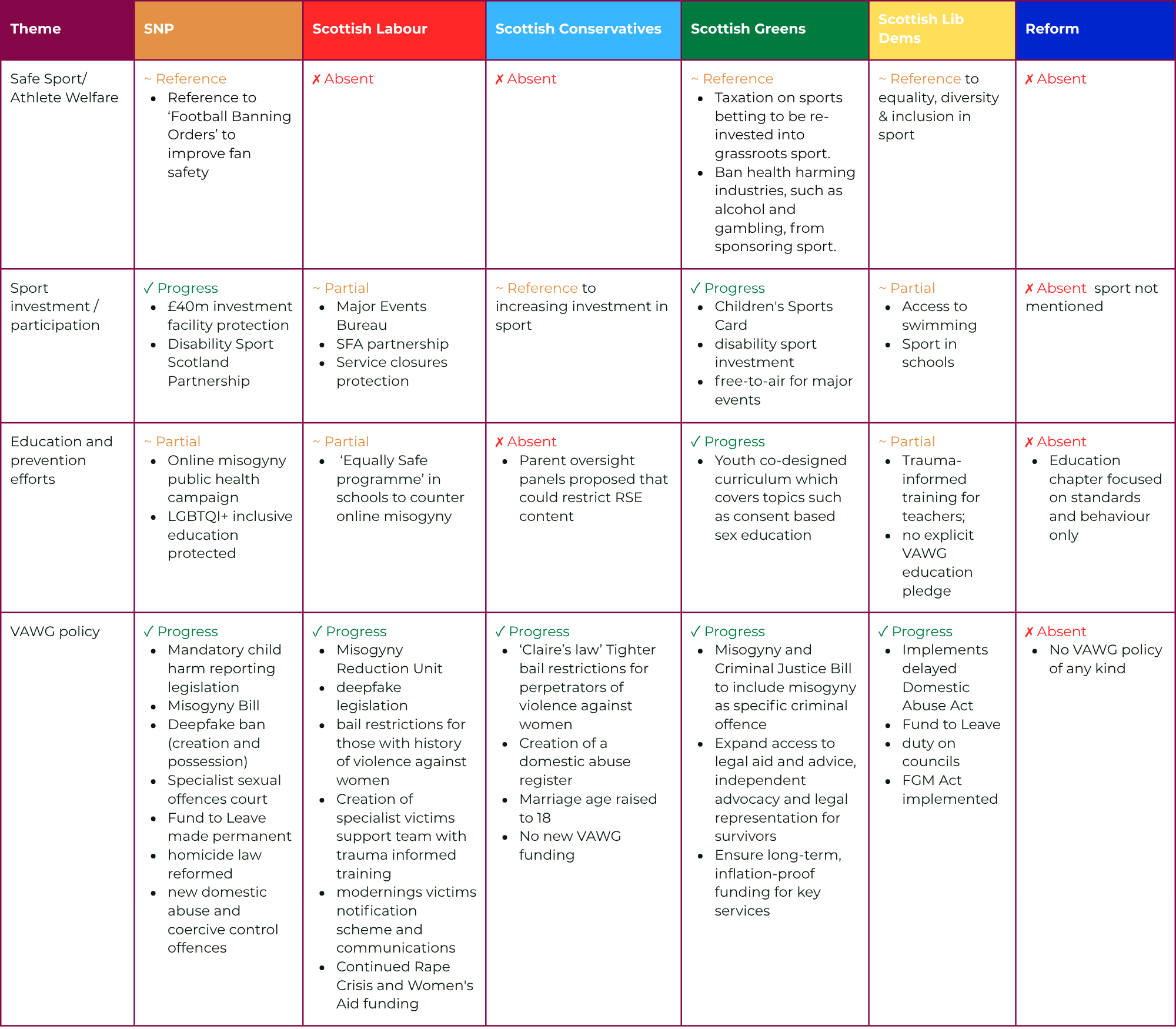
The table below offers a snapshot across six parties and four themes we consider central to safer sport. We chose these themes because they reflect the areas where policy decisions at Holyrood level can make a tangible difference: whether athletes are protected, whether communities have access to sport, whether young people receive education that helps prevent harm, and whether violence against women and girls is taken seriously as both a societal and a sport-specific issue. Following the table, we discuss five key themes that cut across the parties and point to where the real gaps lie.
Key: ✓ Progress | ~ Partial or Reference | ✗ Absent
Absence of a policy is treated as a finding, not a neutral position.
5 Manifesto Takeaways
1. Safe sport is a political blind spot
Not one manifesto, including the SNP's and Greens' dedicated sport chapters, contain any reference to athlete welfare, safeguarding frameworks, abuse prevention within sporting environments, or independent oversight of sport governing bodies. This isn’t because Scotland has the perfect system for keeping people safe - far from it.
Several manifestos are rightly enthusiastic about getting more people, especially children and young women, into sport. However, increased participation without a plan to ensure their safety could mean more women and girls are vulnerable to long-lasting harm. The SNP commits £5 million specifically to sports tasters for young people, the Greens propose a Children's Sports Card and the Lib Dems guarantee a swimming session for every P5 pupil. These are welcome, but women and girls arriving at a sports club enter an environment that, without proper governance and protections, can be a site of abuse, harassment and exploitation.
2. Ambition for VAWG reform meets a familiar delivery gap
There are signs of ambition across several parties on VAWG reform. The SNP's re-commitment to implement Domestic Abuse Protection Orders, banning deepfake intimate images, reforming the homicide law's gendered "crime of passion" defence, and establishing a specialist sexual offences court represents a substantive legislative programme. Scottish Labour's proposed Misogyny Reduction Unit, and the Scottish Lib Dems' focus on the legal gaps that leave survivors exposed - including the presumption that perpetrators, not victims, leave the shared home - show that survivor-centred reform is at least on the agenda. The Greens' Misogyny and Criminal Justice Bill, which would make misogynistic harassment a specific criminal offence, and the Conservative’s ‘Claire’s Law’ to reform bail conditions, add further weight.
Taken together, although not sport specific, these commitments suggest a future parliament that could make meaningful progress on the legal and structural landscape for survivors. The caveat, as ever, is delivery: some of what appears here has appeared before, and the distance between a manifesto commitment and an enacted, resourced, and trauma-informed consulted piece of legislation is often considerable.
3. A sport programme distracted by growth
The manifestos suggest a continued prioritisation of sport as an economic driver, with growth, visibility, and the hosting of major events filling the majority of political promises allocated for sport. We risk the measures of success in sport coming down to the ‘easily measured’ such as participation numbers, infrastructure investment and global profile, while overlooking the conditions within those environments.
As women’s sport grows in Scotland and across the globe, we must not be blinded by that progress, or by a win-at-all-costs culture that prioritises profit and performance over protection. Where accountability is lacking, or decisions are driven by commercial or competitive pressures, gaps emerge that leave room for harm.
The main call from women’s sport as a collective and women athletes has moved on from visibility and investment in the sport they love, and toward protection and safety.
Notably, the Greens disrupt this framing by questioning the role of harmful sponsorships and proposing a distribution of resources back into grassroots sport. This stands in contrast to the broader silence across parties on how financial models in sport actively shape, and at times undermine, safe and inclusive environments.
4. The ‘sport is always good’ narrative goes unchallenged.
Across nearly every manifesto, sport appears as an unqualified positive: a solution to poor health, a vehicle for community cohesion, a showing of national pride, or a pathway out of disadvantage. This framing is an incomplete understanding of the reality of sport for many.
Sport environments, like all environments where adults have power over children and young people, require active governance to be safe. The research is clear that sport carries specific risk factors including physical contact, authority relationships, isolated settings, harmful win-at-all-costs cultures, that make safeguarding a need not a nice to have. Treating sport as inherently beneficial obscures these risks, fuels the ‘hero complex’, further embeds a lack of critical thinking around sport environments, and makes it harder, not easier, to address the root of harm in sport.
5. Politics of ‘protecting women’s sport’
The language of ‘protecting women’s sport’ carries more political weight than ever but none of the substance. It is only in Reform’s foreword that ‘protecting women and girls’ is mentioned in the manifesto, yet its pairing with “from woke policies on…gender”, and no further mention of protecting women and girls in the manifesto itself, tells you everything you need to know. Both the Conservatives and Labour explicitly include the need for single sex spaces, with the latter specifically naming sport.
Absent is any meaningful engagement with the structural barriers, safety concerns, or experiences of women and girls within sport itself. While there is the space for a nuanced and empathetic conversation about inclusion and sports categories, distilling ‘protection of women’s sport’ to exclusionary policies is reductionist at best, and harmful to women and girls at its worst.
Whoever forms the next government, there remains a clear task in supporting their recognition of sport as a space where harm can and does occur. Where there is ambition to tackle violence against women and girls, there is promise that with understanding, this ambition could extend into sporting environments in a deliberate and consistent way, rather than treating sport as separate from wider safeguarding policy.
Every new election is an opportunity for change, for a re-imagination of systems and structures.
Look out for our ‘Safer Sport Priorities for Scotland’ coming soon.
Read our Senedd Election Manifesto Analysis