
Sidelined by design: abuse in sport as a mechanism of political exclusion
Sport is an inherently political arena (whether the IOC cares to admit it or not) and women are being systemically and tactically erased from it through a culture of abuse.
The abuse experienced by any individual in sport causes irreparable, long-term harm. The abuse experienced by countless women at every level and role in sport, occurring in every corner of the world, is a symptom of the dark side of sport that was designed by and for men.
At this scale, abuse in sport is fundamentally a governance and democracy issue, though it is rarely framed that way within sport.
Politics? Not in our game
Much effort is put into maintaining sport’s political ‘neutrality’. [see picture of President Trump sitting next to FIFA President, or President Trump being awarded the FIFA Peace Prize or… you see what I’m doing]. This year’s World Cup, as most global sporting events, wasn’t short of athletes using the platform to voice political statements. Whether it’s controversy over athletes kneeling to protest racial injustice and police brutality, England defender Djed Spence snubbing Thomas Partey’s handshake, FIFA’s ban of the LGBTQA ‘OneLove’ armband, or Heraskevych’s disqualification for wearing a helmet remembering Ukrainian athletes killed in the Russian invasion, the irony is lost on no one that, in their rush to stamp out such statements, sport federations heighten the attention and awareness of an athlete’s cause.
These are just a small number of recent examples of a long-standing tradition of using sport to platform the voices of marginalised people.
However, it is not just brave statements that make sport ‘political’. The status and reach of sport means it has the power to shift mindsets and cultures in society at large, spark conversations, transcend pop culture, and even impact our spending habits; all amplified through the use of online sports betting and social media. I am reminded of England star Marcus Rashford successfully pressuring the government into reversing its policy on free school meals during school holidays as a clear example of sporting status wielding political power. It is also important to remember that many former athletes have direct access to political decision making through their non-elected roles as members of the House of Lords.
To add an additional layer, countries often use major sporting events and international success as vehicles of soft power diplomacy, to project strength, modernity and national pride. We see countries hosting events to showcase global status and increase influence and visibility, but also as a pawn in political discourse. There are numerous examples of countries boycotting Olympic Games in response to global conflict, and as recently as the 2024 Olympic Games, Russia and Belarus were banned from competition due to the invasion of Ukraine.
But of course, sport couldn’t possibly be political.
Who gets to stay in the game?
When an arena has a pull on society, who gets to occupy that space is important.
“Those who perform well rise to the top. It’s all about hard work and who wants it most”… or so we are led to believe. In reality, access to sport, visibility and leadership is heavily controlled. Cultural norms, institutional structures, and abusive practices all shape who is welcome, who is scrutinised, and who is ultimately pushed out.
Women are overwhelmingly the target of abuse in sport. Research consistently shows that women athletes receive a disproportionate share of online abuse. During the Tokyo Olympics, for example, 87% of identified abusive messages directed at athletes targeted women, and similar monitoring during the 2022 World Athletics Championships found that around 60% of abusive posts singled out female athletes.
Globally, research suggests that around one in five elite female athletes has experienced some form of abuse during their sporting careers. The problem extends beyond athletes themselves and into the broader sporting workplace. In the UK, recent research indicates that as many as 88% of women working in sport have experienced at least one form of sexually inappropriate or misconduct-related behaviour.
While anyone can be a victim of abuse in sport at any time, the rate of abuse can increase with visibility, success, and failure. It may come as no surprise that when women do well in sport, gain prominence, or take on leadership roles, the scrutiny and abuse escalates (turbocharged by social media) And we still “can’t win”: when successful women falter on the world stage, the vitriol skyrockets further.
This pattern plays out starkly in stories of women pushing into roles traditionally dominated by men. Rugby CEO Abi Tearney publicly spoke of fearing for her safety in her role due to targeted abuse, while former Women’s Head Coach Charlotte Waltham said she left her role due to a toxic culture of sexism and harassment. The same sexist attitudes are targeted at referees, pundits and journalists in sport across the world.
These stories are not isolated; they illustrate how abuse actively regulates who is allowed to wield influence in sport. Where a woman's visibility, authority, and voice increase, she's seen as a greater threat to the status quo, and that's precisely when abuse is used as a tool to push her out of power. We see the same patterns in politics, where women are subjected to abuse not for performance, but for challenging norms, scrutiny that men in equivalent positions rarely face.
In sport, abuse performs a similar democratic function: it actively regulates who feels able to speak, lead, and participate in public life. The higher the profile, the more power a person holds, and the greater the risk of being silenced, with consequences for who ultimately gets to shape sport and public life.
Side-lined by design
This level of harassment drives self-censorship, withdrawal, and fear, limiting both descriptive representation (the visible presence of women) and substantive representation (the policies and decisions that reflect their interests) of women.
This tactic is more thoroughly researched in party politics where it is estimated that 1 in 5 women leave public life due to online abuse. In sport, the consequences are also visible.
After winning the Euros, England star Jess Carter admitted she questioned whether she had “the courage to go back on the pitch and play again” because of abuse during the tournament. Athletes like Georgia Bell remove themselves from online spaces to avoid social media before major competitions and former footballer Lianne Sanderson has described the impossible choice facing women with public profiles: social media boosts earnings and visibility, but abuse turns engagement into a risk, highlighting the economic consequences of abuse, further pushing women away from sport.
Research across the wider population shows that 58% of women report that sexist abuse made them consider quitting sport altogether, highlighting the broader public health and wellness consequences of harassment.
These examples show the tactics are working. Women are removing themselves from powerful positions, physical and online spaces, shrinking the space they take up, toning down the messages they send, which in turn diminishes the impact they have on wider society. Women can't shape a space they're not welcome in or participating in, and that's the whole point of the abuse aimed at them.
Leaders in governance see the effects firsthand. CEO of Ofcom, Dame Melanie Dawes has warned that “we’re going to lose talent in sport. Lots of places where women, in particular, feel that if they go out there in a public role, they just get abused. And sometimes the toll on them and their families is not something they can manage, and they withdraw.”
Who gets to call the plays?
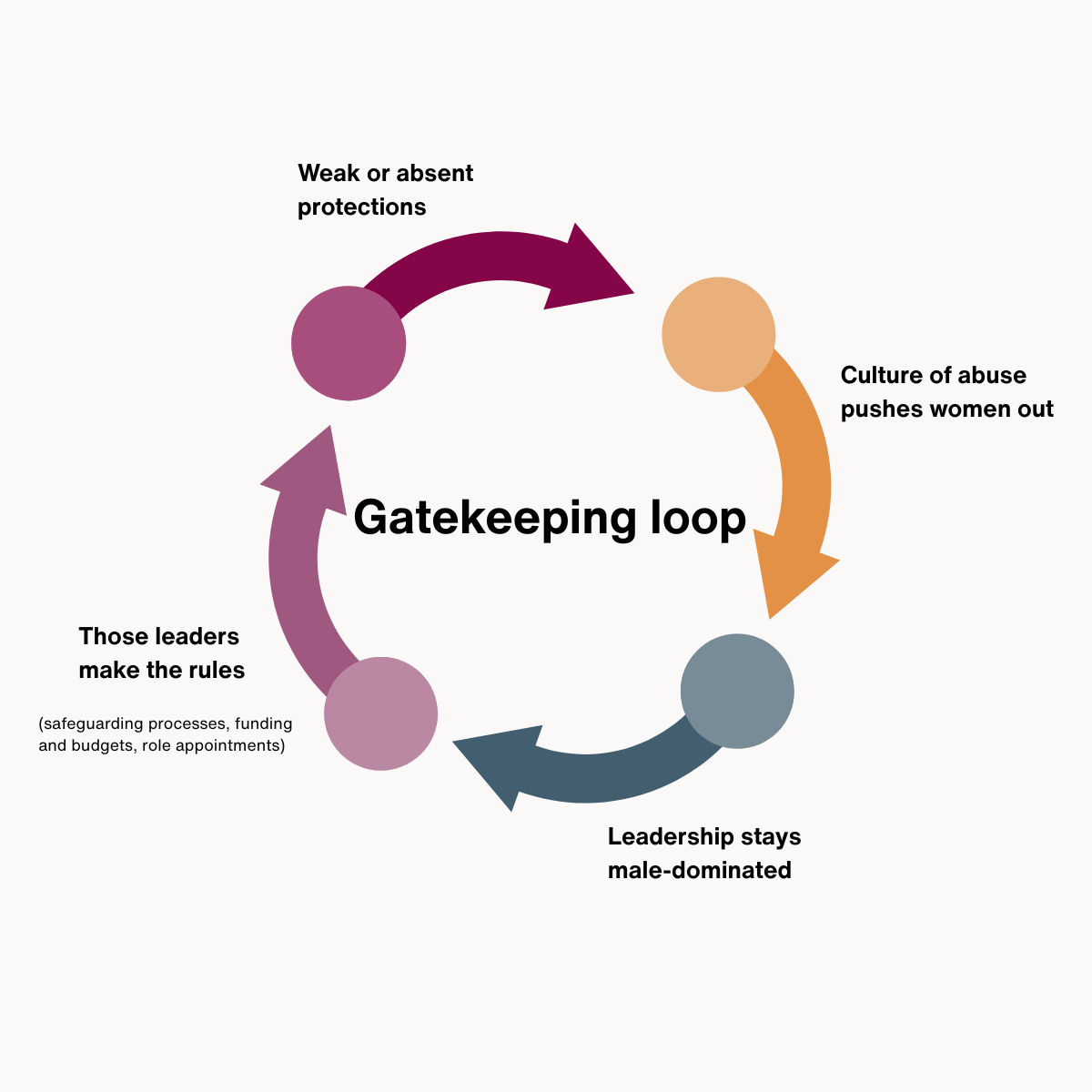
Push women out through abuse, and you don't just lose players, coaches, and pundits, you lose the people who might have shaped how sport is run. Fewer women in the room means fewer women setting the policies, sitting on panels, deciding what gets funded and who gets protected. And when those rooms stay closed, the culture that let the abuse happen in the first place goes unchallenged. Which means more abuse. Which pushes more women out. Round and round it goes.
And the statistics on leadership in sport aren’t heading in a promising direction. Currently, on the boards of UK Sport and Sport England funded organisations, female representation sits at 40.8% in 2024, down from 43.2% in 2020, and men still hold most of the senior roles. Among the specific leadership roles surveyed, women hold just a quarter of Chair positions and around a quarter of CEO roles. That's a lot of men left holding the room when the politicians, sponsors and broadcasters come knocking.The loop doesn't stay contained to sport. We already know sport has the reach to shift public mood, shape culture, even move government policy. Conversations about body image, disability, racism and mental health in wider society have all been pushed forward by athletes willing to use their platform for change. So, if women are being systematically shut out of sport, they're also shut out of one of the most powerful platforms for shaping conversations, norms and policy in the world outside it.
Changing the rules of the game
None of this will change by waiting for attitudes to shift on their own. But how can framing abuse in sport as a democratic exclusion mechanism actually help the cause?
It changes what counts as the problem, and therefore the fix
How you name a problem determines who’s responsible for fixing it, and what fixing it should look like. If abuse in sport is always framed as an individual conduct issue, or referred to as a ‘culture’ problem in a vague sense, the general solutions are training, campaigns and punishment of individuals - all things that are valid and necessary. If it’s also framed as a democratic exclusion mechanism, it creates a need for solutions that are structural (representation, voice, accountability, institutional design), and applies accountability to institutions (federations, boards, sponsors) who often benefit from, and are complicit, in the removal of women’s voices in sport.
It reveals abuse as a form of informal disenfranchisement.
Democracies recognise issues of disenfranchisement such as voter suppression, smear campaigns, and intimidation of candidates as attacks on democratic participation. The abuse of women in sport, whether in person or online, functions in the same way. No sports governing body has a rule saying ‘women can’t be a CEO’, but abuse and intimidation does the work a formal rule, or a physical barrier would have done; the effect of exclusion was achieved by means of abuse.
We can borrow a toolkit that already exists
Much work has gone into working out what supports women staying in public office (or feeling able to enter into it in the first place). Sport doesn't need to invent new interventions from scratch:
Quotas and guaranteed seats for women in sport, with a clear distinction drawn between being in the room and being able to write the rules. Quotas must apply to committees that actually set policy, budgets and strategy, not just advisory panels.
E.g UEFA's amendment ensures two women are guaranteed to sit on the UEFA Executive Committee. This only exists because Laura McAllister, the first and only female on the Committee, spearheaded the change.
An independent, properly resourced reporting mechanism so raising abuse doesn't cost someone their career. An external election-observer-style monitor rather than an internal HR function, if you will.
Governing bodies being held accountable for retention, not just recruitment, tracking not just how many women get the job, but how many are still there one, three, five years later.
Gender budgeting and ring-fenced safe sport funding to force organisations to put money where the policy is, rather than leaving protection and equity to whatever's left over once everything else is paid for.
Culture change gets talked about as the goal, but it’s the wrong place to start. Structure has to come first. You don't wait for a room to become welcoming and hope people stay, you build the room so they can.
Sport is more than competition. It is a public arena that carries immense power and influence. Who occupies that arena is not determined solely by talent or effort, but by which voices are allowed to remain. Abuse functions as a gatekeeping mechanism by shaping participation, silencing dissent, and putting limits on women’s access to leadership and public influence. In this sense, harassment in sport is not merely an individual or cultural problem, it is a political one too, with consequences for governance, representation, and the democratic function of sport itself.